

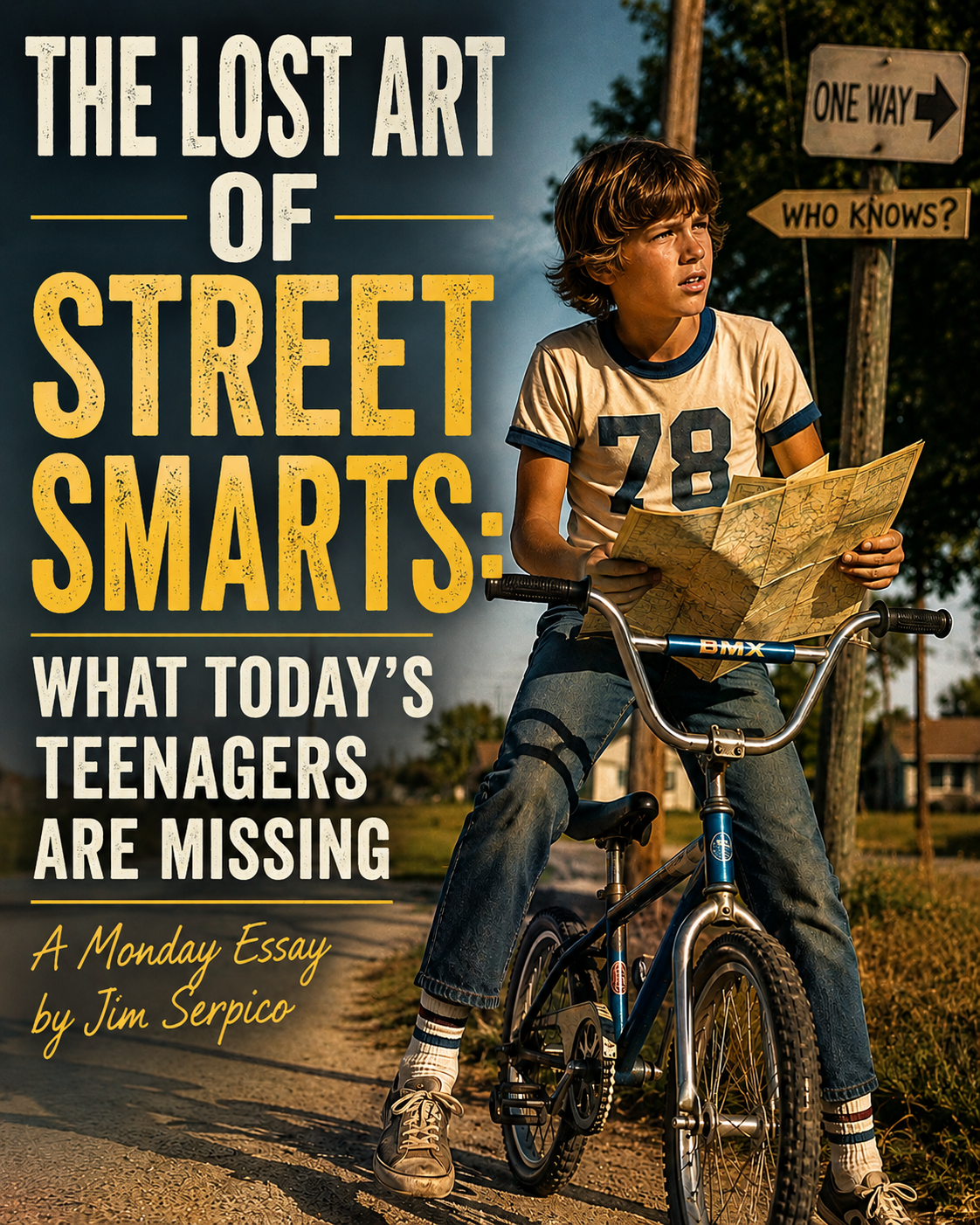
I was talking to a teenager recently and realized something alarming.
If I dropped him in a random town twenty miles from home with no phone, no GPS, no Uber account, and no way to text his mother, he’d have about the same survival skills as a decorative throw pillow.
It’s not his fault.
His generation was raised differently.
My generation acquired street smarts the same way people acquired scars, bad tattoos, and trust issues.
By accident.
Nobody sat us down and taught us street smarts.
We earned them because our parents disappeared for twelve hours every Saturday and somehow expected us to return alive by dinner.
There were no cell phones.
No Find My Friends.
No Life360.
No AirTags sewn into our underwear.
If your mother wanted to know where you were, she started calling houses.
Not you.
Houses.
You’d answer the phone.
“Hello?”
“Is Jimmy there?”
“No.”
“Do you know where he is?”
“No.”
And somehow that was considered sufficient parenting.
We spent entire summers riding bicycles to places we had no business being.
We got lost.
We got directions from strangers.
We knocked on doors.
We got chased out of places.
We missed buses.
We learned how to read maps.
Actual paper maps.
Maps so large that once unfolded they could never be folded back into their original shape by any human being.
Every wrong turn taught us something.
Every mistake became a lesson.
Today’s teenagers don’t get many opportunities to make those mistakes.
They are driven everywhere.
Tracked everywhere.
Texted constantly.
A teenager can now walk from the kitchen to the garage and receive three messages.
“Where are you?”
“When will you be back?”
“Please answer.”
The modern teenager has never truly been lost.
Which means they’ve never had to figure out how to become found.
And that’s where street smarts come from.
Not danger.
Not hardship.
Problem-solving.
Street smarts are really just confidence earned through minor disasters.
They’re the accumulated wisdom of a thousand moments where nobody came to rescue you.
When my generation wanted to meet friends, we had to make actual plans.
You picked a place.
You picked a time.
Then you showed up.
There was no group text.
No location sharing.
No “running five minutes late.”
If your friend wasn’t there, you had two choices.
Wait.
Or accept that you’ve been stood up and move on with your life.
Today, plans are merely suggestions.
Everyone is simultaneously arriving, leaving, canceling, reconsidering, and sending emojis.
Street smarts are hard to develop when every uncertainty has been replaced by an app.
Need directions?
App.
Need food?
App.
Need transportation?
App.
Need to know if rain is coming?
App.
Need validation from strangers?
Unfortunately, also app.
But here’s the good news.
Street smarts can still be learned.
Teenagers don’t need less technology.
They need more unsupervised problem-solving.
Take a train somewhere unfamiliar.
Order food in person.
Ask a stranger for directions.
Get a part-time job.
Handle an angry customer.
Miss a bus.
Figure something out without immediately opening YouTube.
Put yourself in situations where the answer isn’t one Google search away.
Because that’s where confidence lives.
Confidence isn’t knowing the answer.
It’s believing you’ll figure it out.
That’s what my generation accidentally learned.
Not because we were tougher.
Not because we were smarter.
Because we were gloriously, spectacularly unsupervised.
We didn’t build street smarts because our parents had a strategy.
We built street smarts because they had no idea where we were.
And honestly?
Sometimes neither did we.
If this resonates with you, I publish essays like this every Monday morning. If you’d like them in your inbox, you can sign up here.