

People often ask me how I got into television — producing, writing, directing.
The truth is, there was nothing linear about it.
I didn’t study film. I didn’t move to Hollywood with a screenplay in my backpack. I studied music — trumpet, to be exact. I attended Ithaca College as a jazz studies major and played lead trumpet in the Ithaca College Jazz Ensemble. Back then, my dream wasn’t television. I wanted to be a record executive, which at the time still sounded like a real glamorous profession.
After graduation in August of 1990, reality hit hard.
While many of my friends had jobs lined up, I had absolutely nothing. I spent my weekends playing trumpet in a wedding band while sending resumes everywhere I could think of — record labels, booking agencies, music companies. Rejection after rejection after rejection.
Eventually, I started calling some of the same companies that had already turned me down. One of them happened to be a music booking agency called Talent Consultants International. The owner told me the guy they hired instead of me had quit that very day.
“If you want the job,” she said, “it’s yours.”
That moment changed my life.
I started as an assistant for the agents. The company represented acts like Bo Diddley, Wilson Pickett, and Village People. I spent most of my days doing grunt work, but I constantly pushed for more responsibility. I respectfully hounded the owner so often that eventually — probably just to shut me up — she handed me three territories to book their artists:
North Dakota, South Dakota, and Wyoming.
In the entertainment business, these were considered dead zones. Unbookable states.
But I didn’t know enough to know they were impossible.
So I picked up the phone.
I called hotel managers, colleges, tourism offices, local promoters — anyone who would talk to me. Somehow, through persistence and sheer refusal to quit, I managed to put together a tour for Bo Diddley through those states.
That became my first real breakthrough.
The company suddenly saw me differently. They expanded my responsibilities and allowed me to represent their acts in the college market. They began sending me to entertainment conventions where student buyers from colleges and universities would select talent for the upcoming school year.
Looking back, those conventions changed the trajectory of my career even more than the booking itself.
I started building a network. Not in the fake “networking” sense people talk about now. Real relationships. Conversations. Shared meals. Long nights in hotel bars talking about artists, ideas, careers, and opportunities. I also started noticing something important:
Stand-up comedy was exploding.
Colleges couldn’t get enough of comedians.
I heard about a small management company representing comedians that was looking for someone. I applied and got the job. Soon, I was back on the convention circuit — only now I wasn’t selling bands. I was representing comedians performing at colleges around the country.
Again, relationships changed everything.
An agent from a larger firm eventually asked me to help handle some of his comedians because he couldn’t attend every convention himself. One of those comedians, for a brief period of time, was Adam Sandler. I booked Adam into colleges before the rest of the world really knew who he was.
But more importantly, I realized something about myself during that period:
I loved being close to the creative process.
I didn’t just want to broker deals. I liked building trust with artists. I liked contributing ideas. I liked helping shape momentum. I liked feeling part of something before the rest of the world saw it.
At the management company, I worked closely with about a dozen comedians who were all early in their careers. One of them was Denis Leary, who had recently returned from London after his show No Cure for Cancer became a success overseas and was preparing for an off-Broadway run in New York.
Denis and I developed a strong working relationship. I threw myself into helping however I could. The show became a hit. When Denis got the opportunity to tour nationally, he asked me to become his tour manager.
Suddenly, I was on the road for six months traveling the country with Denis and his band at a very young age.
I loved every minute of it.
There’s something transformative about being young and moving through America city by city with creative people chasing momentum. You learn quickly. You learn how shows come together. You learn how audiences react. You learn how to solve problems at 2 AM in strange cities. You learn that talent matters — but endurance matters too.
A few years later, Denis was offered the opportunity to start a production company with Hollywood Pictures. He asked me to come with him and help run it.
That was 1994.
What followed was an incredible 25-year run producing television and film together, including projects like Blow starring Johnny Depp and the FX series Rescue Me.
Eventually, I launched my own company, Milestone TV & Film, which I still quietly run in the background today behind all the bread, pizza, flour, ovens, and dough.
And maybe that’s the point of all of this.
People often look at careers backward and try to turn them into neat stories. They want the five-step blueprint. The master plan. The clean narrative arc.
But my life never worked that way.
Almost every meaningful opportunity I’ve had came from rejection, detours, relationships, curiosity, or simply saying yes before I fully understood what I was stepping into.
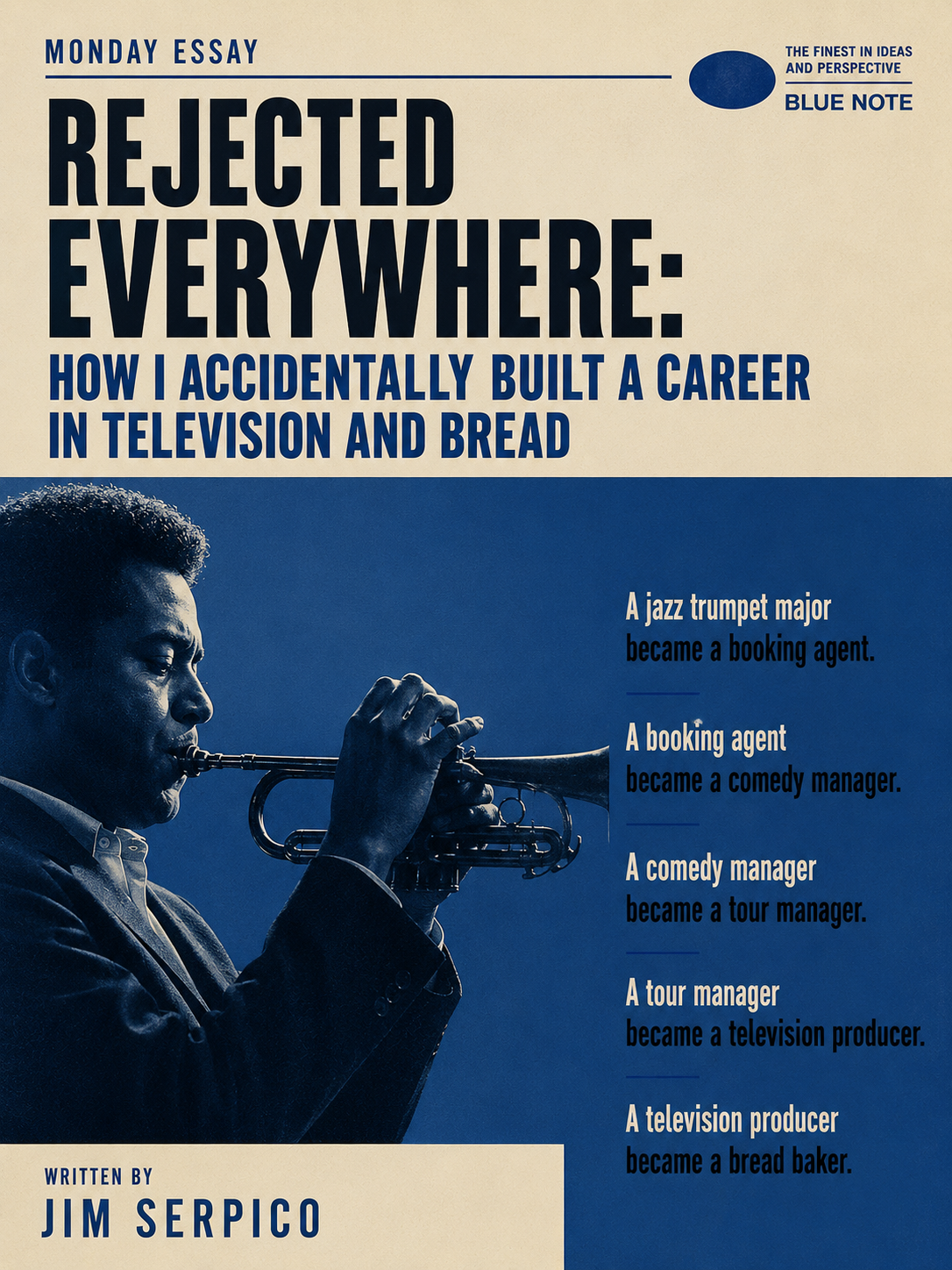
A jazz trumpet major became a booking agent.
A booking agent became a comedy manager.
A comedy manager became a tour manager.
A tour manager became a television producer.
A television producer became a bread baker.
And strangely enough, all of it feels connected.
Because whether I was producing a television show, helping shape a comedian’s career, or making sourdough at 4 AM, the thing underneath it all has always been the same:
I love building things.
I love process. I love craft. I love the collaboration of creative people trying to make something meaningful out of almost nothing.
Show business is still in my blood. It always will be.
But so is the bakery now. So is the oven. So is the dough room. So is the strange satisfaction of feeding people something made by hand.
And after all these years, I think I finally understand something I didn’t know when I graduated college in 1990 unemployed and terrified:
Very few worthwhile lives follow a straight line.
The magic usually happens in the parts that weren’t planned.
If this resonates with you, I publish essays like this every Monday morning. If you’d like them in your inbox, you can sign up here.