

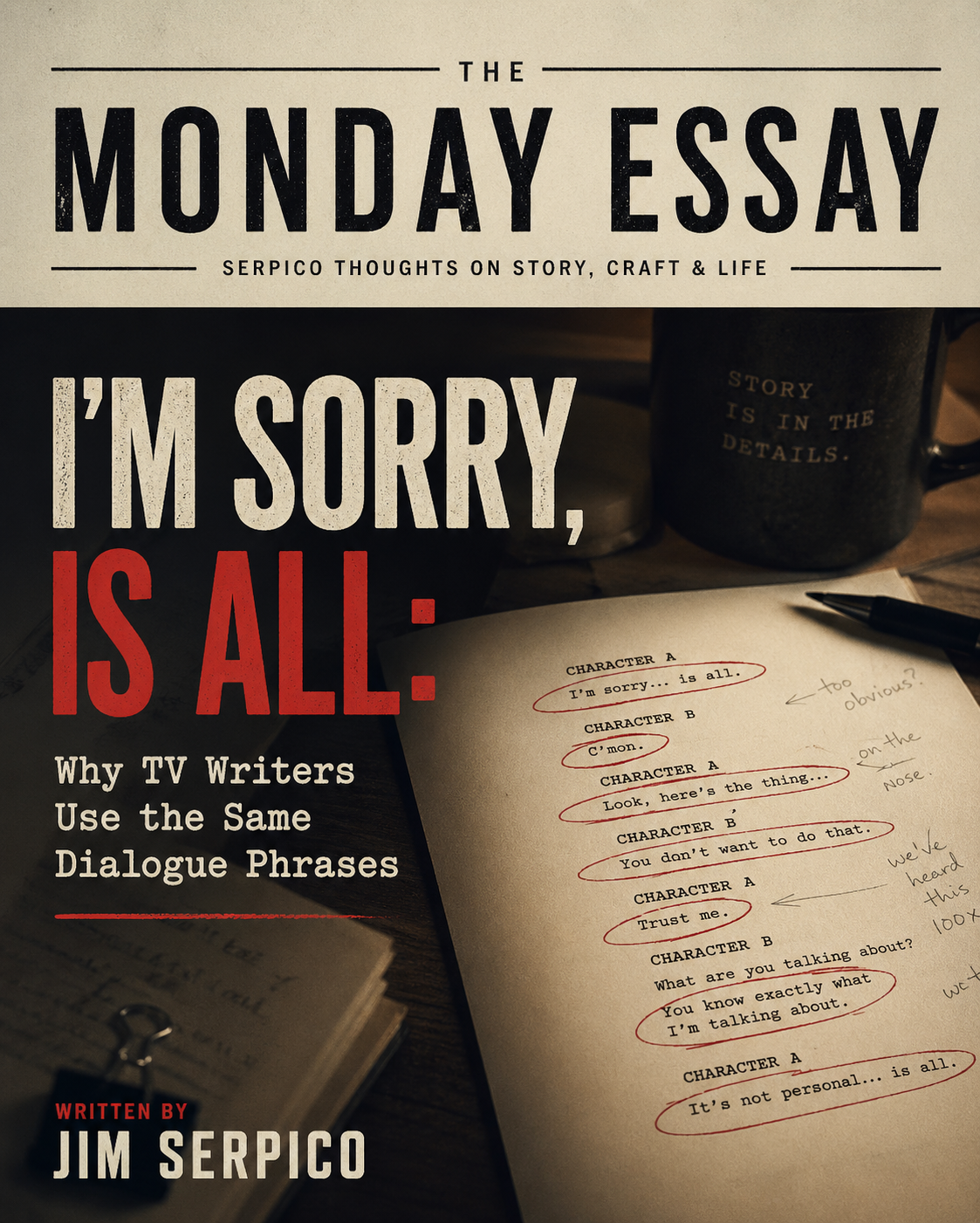
“I’m sorry… is all.”
It’s a line you hear in television over and over again—and once you start noticing these TV writing dialogue phrases, you realize something strange: characters across completely different shows all seem to speak the same way.
“It’s nothing personal… is all.”
“I’m just trying to help… is all.”
“That’s how it works… is all.”
And once you hear it, you can’t un-hear it.
Because nobody actually talks like that.
C’mon… they don’t.
The Writer’s Tell
In real life, people interrupt themselves. They trail off. They contradict. They ramble. They don’t wrap their thoughts in clean little endings like “is all.”
But TV writers do.
Because phrases like this serve a purpose.
They soften a statement without weakening it.
They add subtext without adding more lines.
They let a character say something sharp—and then immediately dull the edge.
It’s a tool.
A very efficient one.
It’s writing doing extra work behind the curtain, is all.
The Shared Vocabulary of TV Writing
Once you start noticing TV writing dialogue phrases, you realize “is all” is just one of many.
There’s a whole shared vocabulary:
“Look…”
“Listen to me.”
“Just hear me out.”
“All I’m saying is…”
“That’s all I’m saying.”
The perfectly mirrored arguments:
“What are you talking about?”
“You know exactly what I’m talking about.”
“Don’t do this.”
“I’m not doing anything.”
The emotional urgency triggers:
“Hey. Hey. Look at me.”
“Stay with me.”
“Talk to me.”
And of course:
C’mon…
The most versatile word in television. It can mean disbelief, frustration, affection, urgency—whatever the scene needs in that moment.
C’mon… it does everything.
Why TV Dialogue Doesn’t Sound Real
Here’s the truth:
TV dialogue is not supposed to be real.
It’s supposed to feel real.
Trust me, real dialogue is messy, repetitive, and often boring. But here’s the thing—TV writing dialogue phrases clean all of that up.
They compress emotion.
They clarify intention.
They speed up scenes.
They turn chaos into something watchable.
That’s all I’m saying.
The Illusion of Natural Speech
These phrases are designed to feel casual.
But they’re not.
They’re constructed.
They’re the illusion of natural speech.
It’s like saying,
“I’m not trying to make a point here…”
Right before making a point.
Or adding,
“Trust me…”
At the exact moment trust is required.
Or warning:
“You don’t want to do that.”
Which, in real life, almost no one actually says.
It’s Like They All Went to the Same School
These phrases show up everywhere for a reason.
Writers learn from the same scripts.
The same influences.
The same rooms.
The same rhythms.
At some point, someone wrote:
“Look, here’s the thing…”
And it worked.
At some point, someone ended a line with:
“…is all.”
And it stuck.
Now it’s part of the DNA of television writing.
You know exactly what I’m talking about.
Breaking the Pattern
The best writers eventually move past these habits.
They stop writing the line that explains the emotion…
and start trusting the moment to carry it.
They stop saying:
“You’re better than this.”
And let the silence do the work instead.
Because real people don’t soften everything.
They say the thing.
And then they sit in it.
No bow.
No polish.
No “is all.”
Stay with me.
That’s where real dialogue lives.
Conclusion: It’s Just a Phrase… Is All
This isn’t a criticism.
It’s an observation.
A small crack in the illusion that lets you see the machinery underneath.
And once you see it, you start noticing all of it—
the rhythms, the patterns, the shared language that connects writers who have never met.
Look… it’s not a bad thing.
It’s craft.
But like any craft, it can drift into habit.
And habit starts to sound the same.
C’mon… you hear it now.
Is all.
If this resonates with you, I publish essays like this every Monday morning. If you’d like them in your inbox, you can sign up here.